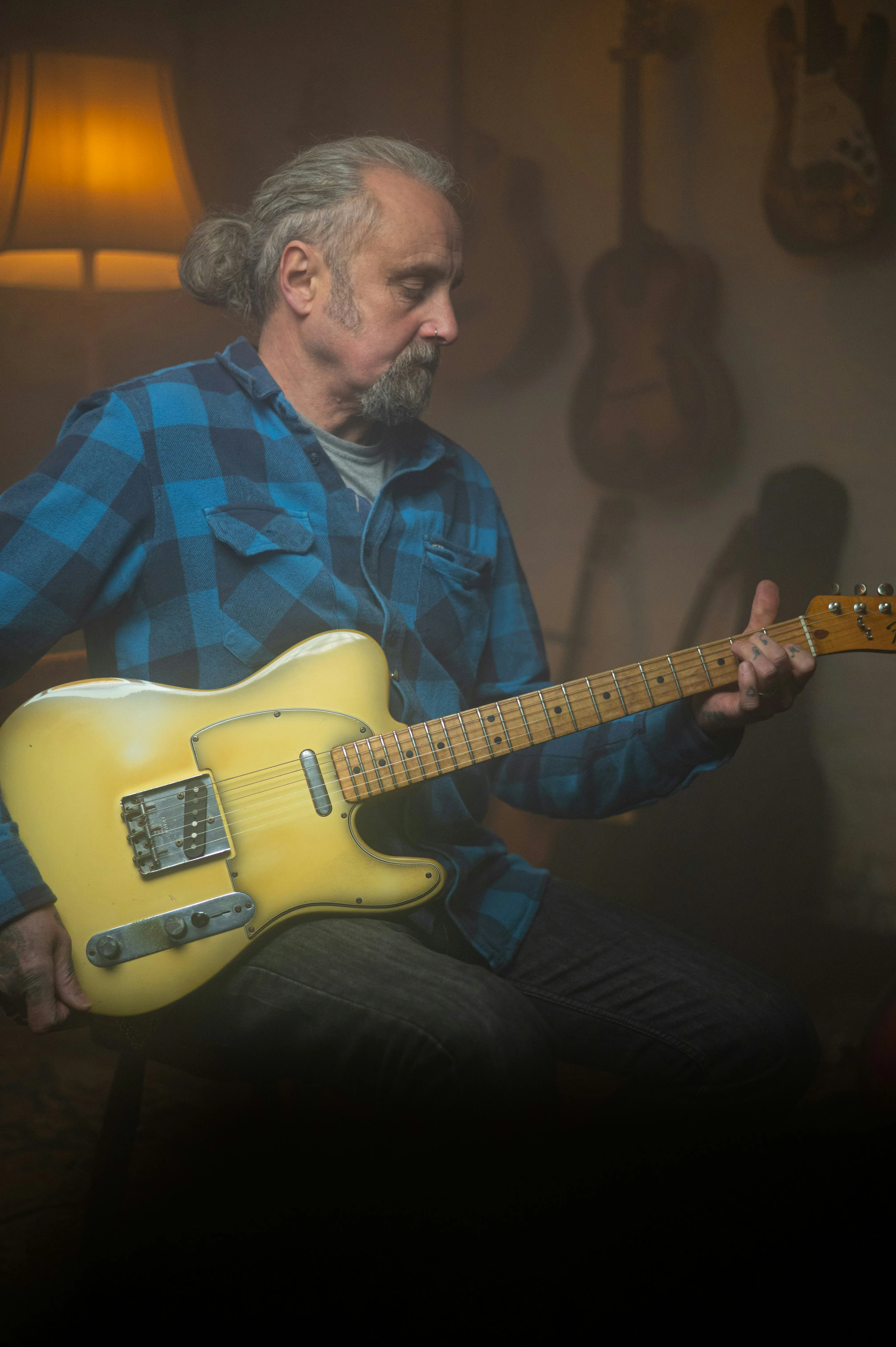
Nobody tells you the real reason most adults quit guitar. It isn't age. It isn't talent. It isn't even time — though that's what most people blame. Estimates consistently place the beginner dropout rate somewhere between 60% and 90% within the first year, with the biggest quit window landing in the first one to three months — before calluses form, before chord changes get clean, before any of it feels rewarding (Music Mentor; Holistic Musicianship). The number one reason Fender identified in their 2021 research: not feeling like they're making progress fast enough. That's a solvable problem. Age is not why adults fail at guitar. The approach is.
I picked up my first guitar at 12 years old. I put it down almost immediately. Not because I couldn't do it — because I didn't have anyone around me who took it seriously. None of my friends played. There was no band, no practice partner, no one to show me that it was possible. I didn't pick it back up until I was 28, and by then everything was different — including what I needed the guitar for. This guide is built from that journey: what actually worked, what wasted time, and what I wish someone had told me before I walked into that music store on a Friday evening and bought a Yamaha FG800.
Key Takeaways
- Between 60–90% of beginner guitarists quit within the first year — most in the first 1–3 months, before chord changes and calluses develop (Music Mentor; Holistic Musicianship). The top reason is not feeling like they're progressing, not being too old.
- 15 minutes of focused daily practice is enough to make real progress — consistency matters far more than session length.
- Start in the key of G. Three chords (G, C, D) cover hundreds of songs and give you an immediately usable foundation.
- Getting your guitar professionally set up is one of the highest-impact things a beginner can do — a poorly set-up guitar is genuinely harder to play.
- The moment it clicks for most adult beginners — when playing starts to feel like expression instead of effort — typically happens around 30 days of consistent practice.
Is It Actually Possible to Learn Guitar as an Adult?
In 2021, Fender and YouGov surveyed more than 10,000 guitar players and found that 90% of beginners quit within their first year. The top barrier they identified was not age — it was feeling like they weren't learning fast enough (Fender/YouGov, 2021). That's a critical distinction. Adults don't quit because they're too old. They quit because nobody gave them a realistic system for making steady, visible progress.
The answer to the question is yes — and we go deeper on the age anxiety specifically in our post Is It Too Late to Learn Guitar After 40? Adults learn guitar at 30, 40, 50, 60, and beyond, and many of them play better than people who started as teenagers because their motivation is intrinsic. They chose this. No parent signed them up. No school required it. They walked into a music store because something pulled them there — a Sunday morning worship service, a song on the radio, a retirement goal, a feeling that they wanted this one thing for themselves. That kind of motivation is a genuine advantage.
My motivation at 28 was specific: I was in a worship band as a vocalist, and our guitarist stepped back because he was burnt out. The band felt incomplete. Something was missing in the sound, and I could hear it every Sunday. So I stopped at a music store one Friday evening after work, bought a Yamaha FG800, and decided to figure it out. That specificity — playing for a real reason, with real people, on a real deadline — is what made the difference between the 12-year-old who quit and the 28-year-old who didn't.

What Actually Makes Adult Learners Different
Adults bring real advantages to learning guitar that teenagers don't have. A 2022 YouGov survey found that guitarists who learned with intrinsic motivation — their own decision, their own goal — were significantly more likely to describe playing as feeling natural than those who started under external pressure (YouGov, 2022). Adults almost always fall into the intrinsic category. You chose this. That matters more than most people realize.
Adults also analyze patterns better, connect new information to existing knowledge faster, and understand why a technique matters before they practice it — which makes deliberate practice more effective. The disadvantages are real too: less time, more self-consciousness, a tendency to compare yourself to professionals who started at 12, and hands that may take slightly longer to build callouses. None of those are dealbreakers.
The one thing I wasn't ready for was the gap between what my musical mind wanted and what my hands could do. I had been a vocalist in church since I was five years old. I understood music. I could hear what I wanted to play. But my fingers didn't know that yet. That gap — the mind knowing, the hands not following — is the most frustrating part of the early weeks. It passes. But you have to be patient with yourself through it, and you have to resist the urge to move on before your hands have caught up to your intentions.

What Are the Biggest Mistakes Adult Guitarists Make?
Most adult beginners don't quit because the guitar is too hard. They quit because they make a handful of specific mistakes in the first 60 days that make the guitar feel impossible when it shouldn't. Here are the ones I made and the ones I see most often in students.
Trying to do too much too soon
I made this mistake immediately. I tried to sing while playing within my first few days, because singing is what I do. That was the wrong order. My hands needed to learn the guitar without my voice competing for my attention. The technical term is "cognitive load" — your brain can only manage so much at once, and if you're trying to play, sing, and keep time simultaneously before any of it is automatic, nothing gets done well. Learn one thing at a time. Singing while playing comes after playing alone is comfortable, not before.

Skipping the guitar setup
Nobody warned me about this one. A guitar that hasn't been set up properly by a technician is genuinely harder to play than one that has been. High action (the distance between the strings and the fretboard) means you have to press harder to get notes to ring — which causes more finger pain, more buzzing, and more frustration. After I had the saddle and nut of my FG800 sanded down by a tech, the guitar felt completely different. I could press more comfortably, chords rang more cleanly, and practice stopped feeling like a physical battle. Get any guitar you buy set up before you practice on it. It's usually $40–60 and worth every cent.
Practicing without a plan
The second-most-common thing I see: adults sit down with the guitar, noodle around for 30 minutes, and then wonder why they're not improving. Unstructured time on the guitar feels productive but often isn't. You need to know what you're working on before you pick the guitar up, and you need to track where you're stumbling. I kept notes on my chord sheets — literal pencil marks at the spots in a song where I lost the rhythm or fumbled a transition. Those marks told me exactly what to practice next session.
Comparing yourself to the wrong people
I was around gospel artists my whole life who played by ear, had decades of chord knowledge, and made everything look effortless. That was the wrong comparison group. Your reference point should be where you were last week, not where someone else is after 20 years. The only useful comparison is yourself over time.
Does Practicing Guitar 15 Minutes a Day Actually Work?
The practice approach that got me from zero to playing full songs in 30 days wasn't complicated. Fifteen focused minutes a day during the week. One longer session on Saturdays — about an hour — where I rehearsed songs I was preparing to perform. That's it. The key was the structure inside those 15 minutes, not the length.

Fifteen focused minutes every day beats two unfocused hours on a weekend. Muscle memory builds through repetition over time, not through marathon sessions.
I built the complete version of this system — with the exact daily structure, practice charts, and song progressions — into my beginner guide Play Guitar with Just 15 Minutes a Day. But here's the core of what it looks like in practice. (For the full story of how I protected those 15 minutes around a two-hour commute and a demanding job, see how to find time to practice guitar with a full-time job.)
During the week, I worked only on the specific thing that had given me trouble in the previous session. If the G-to-C transition was where I fumbled, that's what I practiced for 15 minutes. Not the whole song. Just that transition, slowly, until it felt clean. On Saturdays, I brought everything together and played through the actual songs — but I deliberately stayed in the key of G for the first months. Everything I learned, every song I practiced, lived in G major. The reason: I needed enough chord familiarity to play music that actually sounded like music, not just exercises. G major gave me G, C, D, and Em — four chords that cover more songs than any other key on the guitar.
The Saturday sessions had one additional rule: I performed the songs after practicing them, not during. I'd run through a song a few times in rehearsal, then play it the way I would play it for real — no stopping, no going back. Playing through mistakes instead of stopping when you make them is one of the most important habits you can build. If you miss the chord the first time through the chorus, the chorus comes back. You get another chance. That's true in practice, and it's true on stage.
The Weekly Practice Structure That Worked for Me
- Monday–Friday: 15 minutes, focused on one specific challenge from the previous session
- Saturday: 60 minutes, full song rehearsal in a single key (G to start)
- During practice: Mark the spots in your chord sheet where you fumble — those are your next practice targets
- Key rule: Don't stop mid-song when you make a mistake. Play through it.
- First milestone: Get G, C, D, and Em to feel automatic before moving to any other key
What Actually Happens in Your First 30 Days of Learning Guitar?
I can tell you from experience — and from watching dozens of adult students go through this — that the first 30 days follow a fairly predictable pattern. Week one is physical: your fingertips hurt, chords sound muted or buzzy, and switching between shapes feels impossibly slow. This is normal. Your fingers are building callouses and your brain is mapping new motor patterns. Neither happens overnight.
Week two is when most people hit their first wall. The initial excitement has worn off, you're not yet good enough to feel rewarded by what you're playing, and it's tempting to wonder if this is going to work. This is the critical week. The people who push through week two almost always make it to week four. The people who stop here almost always say they quit because they weren't talented enough, when the real reason is they stopped two weeks before it got good.
For me, the moment everything clicked was when I could play and sing at the same time. That happened around 30 days. It sounds small, but it changed everything. Suddenly I wasn't just practicing exercises — I was making music. I could pick a strumming pattern I heard on a recording and approximate it after a little time with it. I could play through a full song without having to consciously think about every chord. The guitar stopped being something I was fighting and started being something I was using to express what I already heard in my head.
The moment that confirmed I was onto something came at a band retreat. The group called me up to play a song I hadn't rehearsed. I didn't know the chords cold. But I'd stumbled across a video that week about playing only the root and the fifth of each chord instead of the full shape — a simplified voicing that sounds complete in a band context. So that's what I played. The whole band turned and looked at me and asked: "When did you start playing again?" Thirty days in. That question told me everything.

The Honest Answers to Every Question Adult Beginners Ask
After teaching adult beginners for years, the same questions come up every time. Here are the honest answers — not the ones designed to make you feel good, but the ones that will actually help you.
How long will it take?
I can't give you a number, and anyone who does is guessing. What I can tell you is that it depends almost entirely on how bad you want it. Not talent. Want. Consistent 15-minute daily practice will get you playing real songs faster than you think. But there's no shortcut to the repetition. With the system in this guide, most students are playing recognizable music within 30 days and feeling genuinely comfortable within 3 to 6 months. But that's only true if you actually practice every day.
Am I too old?
No. This is a discipline question, not an age question. I've watched people in their 60s learn to play guitar with more commitment than teenagers half their age. Age affects how quickly you build callouses, maybe. It doesn't affect how quickly you can learn a chord shape, understand a progression, or develop an ear for music. Your brain is more capable than you're giving it credit for.
Should I take lessons?
Community and guidance matter more than formal lessons. What helped me most wasn't a teacher in a room — it was being around other players who kept things simple and adapted to where I was. If you can find that — a band, a guitar group, a church team — that environment will accelerate your learning faster than weekly lessons alone. If lessons are your path, find a teacher who specifically works with adult beginners. The approach is genuinely different.
What guitar should I start on?
Start on whatever instrument matches the music you want to play. If you want to play acoustic singer-songwriter music, buy an acoustic. If you want to play worship or rock, buy an electric. The fundamentals transfer. More importantly: whatever guitar you buy, have it set up by a technician before you practice on it. A high action makes any guitar harder to play than it needs to be. That one step will change your experience more than the brand of guitar you choose. You can find solid beginner acoustic guitars at zZounds, and excellent used options through Reverb if budget is a factor.
Want to see what focused, beginner-friendly guitar practice actually looks like? This lesson from Mark has helped nearly 30,000 adult beginners take their first real step:
Free Beginner Resources
Ready to start? Get the tools that go with this guide.
Chord charts, a 4-week practice schedule, and the Circle of Fifths tool — all free, all built for adult beginners.
Download Free Resources →Frequently Asked Questions
Can I learn guitar as an adult with no musical background?
Yes. No musical background is required to start learning guitar. Many successful adult guitarists came to the instrument with no prior experience. A musical background can help with ear training and understanding chord theory faster, but it's not a prerequisite. Start with three chords in G major — G, C, and D — and build from there. The structure comes with time.
How long does it take to learn guitar as an adult?
With 15 minutes of focused daily practice, most adult beginners can play simple songs recognizably within 30 days, strum through a full set of songs within 3 months, and feel genuinely comfortable on the instrument within a year. The timeline depends almost entirely on consistency — not talent, not age. A 2021 Fender survey found the top barrier for beginners is not progressing fast enough, which a structured daily practice habit directly addresses (Fender/YouGov, 2021).
Should I learn guitar on acoustic or electric as an adult beginner?
Start on whatever matches the music you want to play. The technique fundamentals transfer between both. More important than which type you choose: get the guitar set up by a technician before you practice on it. A high action makes any guitar harder than it needs to be, and beginners often interpret that difficulty as a personal limitation when it's actually a setup problem. See our full breakdown in our S-style guitar guide for more on what makes a guitar playable.
Is 15 minutes of guitar practice a day enough?
Yes — if those 15 minutes are focused and consistent. Fifteen concentrated minutes of practicing one specific challenge outperforms 90 minutes of noodling through songs you already know. The key is knowing what you're working on before you pick the guitar up, and tracking where you stumbled in the previous session so you know exactly where to start. Daily short sessions build muscle memory faster than sporadic long ones.
What should I learn first on guitar as an adult beginner?
Start with the key of G. Learn G, C, and D major — three chords that cover hundreds of songs — and practice making clean transitions between them before adding anything else. Once those feel automatic, add Em (G's relative minor) and you have the foundation for the vast majority of everything you'll ever play. Use the Circle of Fifths tool to see exactly how G, C, D, and Em relate to each other and what comes next.
Sources
- Fender / YouGov — Guitar Player Landscape Analysis, n=10,644, Oct 2021, retrieved 2026-05-30
- YouGov — Guitar learning methods and retention, n=3,000, Aug 2022, retrieved 2026-05-30
- Music Mentor — "Why Do Beginner Guitar Players Quit?", retrieved 2026-05-30
- Holistic Musicianship — "Why So Many Beginners Quit Guitar", retrieved 2026-05-30
- Personal teaching experience — Mark Claiborne, MTWL Media, 2026